

FEP: Color-coded FEP Teflon® is extruded over each single conductor. The single insulated conductors are twisted and insulated with an extruded white jacket of FEP Teflon®
Key Features
- Rated for continuous use at 400° F (205º C).
- Available in nickel plated, Silver plated and Tin plated conductors.
- Available in Type 3 , 4 and 6 Conductors
- Singles: PFA Teflon®‡ 8 mil nominal
- Jacket: PFA Teflon®‡ 10 mil nominal
Comparison to Other Constructions:
Abrasion Resistance – Fair
Chemical Resistance – Good
Moisture Resistance – Good

Application Note
Teflon Insulated RTD Wire Non Shielded with FEP insulation is designed for precise and reliable transmission of temperature signals in industrial measurement systems. Engineered for stability and durability, this cable ensures minimal signal loss and high accuracy in resistance temperature detector (RTD) applications.
Each conductor is insulated with color-coded FEP Teflon and twisted together, followed by an extruded white FEP jacket that provides additional protection against environmental factors. The cable is capable of continuous operation at temperatures up to 205°C and performs effectively in extreme low temperatures down to -200°C, making it suitable for both high-heat and cryogenic applications.
Available with nickel plated, silver plated or tin plated copper conductors, the cable minimizes electrical resistance and enhances signal integrity. It is offered in multiple configurations including 3, 4 and 6 conductors, allowing compatibility with various RTD sensor setups.
The FEP insulation provides excellent chemical and moisture resistance, ensuring long-term reliability in harsh industrial environments such as chemical processing plants, laboratories and process control systems. While offering fair abrasion resistance, the cable is ideal for installations where chemical exposure and temperature stability are primary concerns.
This RTD wire is widely used for extending and transmitting temperature signals in instrumentation systems where accuracy, durability and environmental resistance are critical.
RTD cables transmit or extend the signal produced by Resistance Temperature Detectors (RTDs) and are commonly constructed with copper-stranded wire coated with materials like nickel, silver, or tin to reduce added resistance in the temperature measurement signal and endure various environmental conditions.
Related products
-
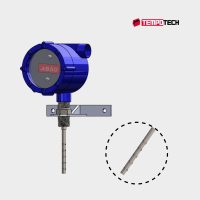
WMTT01 Wall Mount Temperatrue Sensor RTD